

May 3rd, 2025
A DIFFERENT PERSPECTIVE
I admit that I have known for almost my entire dance life that I am different than most of the dancers in my community. I have always had different goals and my mission as both a performer and a teacher has been different. Now I am by far the longest lived dancer here, and the differences are in some ways more obvious than ever, because my peers are no longer around. Some have stopped dancing long ago, some are dead. I often feel this separation between and other dancers in my own community.
Because there was no one here for me to learn from, I spent most of my time traveling to study. While there were obvious disadvantages, there were some truly excellent advantages. First and foremost, after a few years I realized that there are good and bad teachers in the dance, and I resolved to be one of the good ones. After a few years I stopped taking classes with whoever came down the pike and concentrated on studying with people that I thought could give me what I needed and wanted to become a “real dancer”. I wanted to give the dance everything I had and it was only possible for me if I could separate chaff from grain so to speak, so my studies with so many dancers early on helped me immensely to grow my knowledge of what was dance truth and what was not. And different dancers brought me different gifts:
Jodette, my original teacher with her style that was very much influenced by Tahia Carioca, a dance Great, as I was later to learn.
Badawia, with her American Cabaret style spiced with cultural accents. I learned as much sitting in her kitchen as I did watching her on stage.
Cassandra Shore, who through her performances alone taught me the value of integrity in movement and understanding that dance values differ from one dance to another. ( American Cabaret is a separate dance from Raqs Sharqi, which is again separate form Oriental Tanza.)
Nadia Hamdi, who was my first experience with one of my beloved Egyptian dancers. her sweetness, her simplicity of movement and her complexity of understanding really drove home to me the necessity of delving beneath the movement to the heart and soul of the dance.
Morocco, my beloved Mz M, who encouraged me from the day we met in person and stood by me during some very hard times.
Mona Said, who enthralled me so much on video and even more so on the live stage. She taught me just how important minimalism can be, letting emotion take form fully and expressing it complete without ever making an overstatement physically.
April 8th, 2025
THE ART OF THE COSTUME
I started making costumes almost as soon as I started dancing, in 1974. I spent my performing years designing and building costumes for dancers, making everything from elaborately beaded belly dance costumes to complicated folkoric clothing. I also designed and built all kinds of costumes, and supervised the costume shop in Eastern Washington University’s Theatre Department for over 7 years. So, I have a pretty good idea of what costuming is all about.
Recently on my teachers’ forum, some dancers were posted in the most revealing costumes yet. One of them, except for some glitz work, was a completely nude body suit. This costume left exactly nothing to the imagination. The other costume was stocking with seams, a badly fitting bra top and a pair of short shorts that did not cover very much territory and had two huge handprint designs on them. The dancers were supposedly belly dancers, but who could tell since I don’t think anyone would be paying attention to their dance. The costumes were too revealing for them to do their job. For me, that was the point. My opinion was not so much slut shaming as it was based on the fact that no one watches the actual dance if a costume covers so little.
So, it comes down to this. What is the purpose of a costume? A costume should enhance a character and help to bring it to life, or in the case of dance, it should help us not only to define the dance we are seeing, but also help us to actually see the dance itself. Some examples: If an actor is playing Henry the 8th, it is best not to dress him in a hula skirt. The job of his or her costume should be to give the help the audience determine who the character is, and also to help the actor feel a stronger tie to the character in order to best portray him. Similarly, a dancer should be costumed in such a way as to enhance the dance, not only in order to help define the movements of any given dance, but also to enhance the feeling of being the dancer. A costume should also give the audience a clue as to what kind of dance she/he is performing. A dancer should wear a costume that does not distract from the dance itself, but instead should enhance it. As a person who spent some 45 or so years as a professional costumer, I am entitled to define the job a costume should do.
That is my problem with a nude body suit with a bit of glitz on, or a pair of short shorts with huge hand prints across the butt. It isn’t whether or not these are sleazy choices for something to wear on stage. This is not about slut shaming. My problem is instead with the intent of the costuming. Are these kinds of costuming meant to enhance the dance or to titillate? If a dancer wants to titillate, there is another kind of dance that is more appropriate for the costume. Is this costuming meant to enhance the dance, or is there another goal in mind?
March 31st, 2025
DANCE INTEGRITY
Last night I attended a dance performance by Alonzo King Lines Ballet.
I can only begin to describe the perfection of this performance, from movement, to music, cultural essence, to the human connection. I wish everyone could have been there.
These people are DANCERS. In every movement, no matter how big or small, we could see pure integrity. It was so fascinating to watch the turning of a head begin deep in the lower torso as a dancer understood what it means to have the full support of the body for something that could have been otherwise so insignificant. Every movement by everyone on stage had full intention, full understanding and surety. And it was automatic. They didn’t have to think it through. It was the result of inherent physical and emotional ability paired with great training.
Mr. King’s choreographies were so impeccably informed by the music that nothing happened on the stage that did not compliment the feeling that the music evoked. He “calls his works ‘thought structures’, created by the manipulation of energies that exist in matter through laws that govern the shapes and movement direction of everything that exists”. (From the program.) This is so evident. I felt my own body responding as the dancers moved, so that I could feel my own backbone elongate as a dancer lifted an arm, my own core muscles prepare as an undulation was beginning. And emotionally, the dances brought forth so much. At one point something so beautiful was happening on stage that my eyes teared up. At the same time, I noticed my friend who came with me lift her fingers to dab at her eyes. I think the entire audience responded. This was TARAB!
Culturally the performance spoke of varying backgrounds and ideologies. The dancers themselves are from all over the world. It was a combination of provenance through use of movement and dance values, and innovation through Alonzo King’s unique approach. The music spoke of various cultures and concepts. The choreographies were a response to the music, every time manifesting through movement what is felt in the heart and soul.
The costumes did exactly what costumes are supposed to do. Every costume enhanced the idea of the dance, and the movement of the dancers. No piece of fabric overpowered the movement or made the dance disappear. Nothing was so provocative that you waited for something to fall off.
Finally, every dancer’s ego was submerged beneath the dance itself. No one felt the need to compete, or prove they were the best, and yet all dancers infused their individual essence into the work. All energy went into creating a performance with integrity on all levels. There was complete immersion in the experience of the dance.
I am a Middle Eastern dancer, so why am I writing so prolifically about a western form? Because I only wish that we consistently found such care for our own dances. We do not. Quite often we start with bad training.
Quite often we see dancers in our own field not understanding how to dance with the music they have chosen, or even knowing it IS music they should or should not dance with. Quite often dancers do not know how to physically respond to the texture, the feeling, the essence of the music. As in any other dances, there are ways to do things in the dances of the Middle East and North Africa, that have cultural essence and speak to us about the people who’s dances they are. when we ignore that, we are not only ignoring a few “rules’ about dance. We are disrespecting entire cultures.
Quite often it is the personal ego that is front and center, and not the dance itself. So many dancers do not dance for the sake of the dance, but to put themselves on the stage, to let people see them. The dance gets lost in physical overstatement, in a “look at ME” attitude, in the dancer feeling more important than the dance she/he professes to “love”.
If it was possible for me to make a wish and have it granted for our own dance forms, it would be that we could somehow endow every dancer with the kind of dance values and integrity that I saw in the Alonzo King performance. I have been fortunate enough to see it happen now and again. and those performances stand out like the precious gems that they are.
March 8th, 2025
ON BEING AN OLDER DANCER
In July of this year, I will celebrate my 51st year of being a dancer. I took my first class on July 1st, 1974. I had no idea just how that class would be the first step in forming my Life’s Work. Since then I have spent most of my time studying, performing and teaching various dances from North Africa and the Middle East. I started when I was 21 and now I am 72 years old. Things in the dance world have changed immensely since I took that first class.
As I think back over the years, I remember being so immersed in the dance that it felt like my Life’s breath rather than just something I was doing. I was eager and hungry for every scrap of knowledge about the dance. I wanted to BE a belly dancer. It took many years before I came to a point where I could honestly say that I AM a dancer……. and that becoming is a never ending process. I don’t know if I ever went through that “I’ve arrived” phase that so many people seem to go through before they realize that the journey to becoming a dancer never arrives at it’s destination. It is eternal.
Now that I am a “retired from performance” dancer, I am very much aware that somewhere along the line, I BECAME a dancer, and it fits so well that it seems to permeate every cell of me. I am never not a dancer now. I have no doubts about it. It is who I am, but like with being a human being, it is a continuous work in progress.
I’ve studied Egyptian, Turkish and Lebanese belly dance, and American Cabaret. I’ve studied Greek, Egyptian, Lebanese, Algerian and Turkish folk dances. I spent time one year learning Persian classical dance, and later Persian pop in the clubs in Seattle, dancing with the Persian girls. I spent years learning Arabian Gulf and Saudi dances. I finally realized that I could never be truly excellent at them all, and focused on in depth studies of a few of these dances to gain a true, deep understanding and sympatico. Its always so much more than movement. An entire culture emerges when we dance a dance with the knowledge that we are representing something so much bigger than we are.
I have seen the dances evolve and devolve in so many different ways. My dance icons and mentors have remained the same, and I have a few newer ones now as well. Nearly always they are dancers from the various cultures, though sometimes not. The current dance incarnations do not enthrall me, except for a very few dancers who seem to still capture the essence of what the dance is. Those who still have that indefinable in words cultural soul of any given dance. Now it seems, the dance is drowning in overstatement and hypersexual movement paired with a “Look at ME” attitude. I hope this is another dance phase and not the culmination of it, brought about by too much western global influence.
One thing about being an older dancer today that really is bothersome is that so many younger dancers do not seem to realize that a wealth of dance information and knowledge can be had simply by listening to older dancers. My generation has had and still does have a plethora of people who did not care to study beyond learning a few movements and looking pretty in the outfit. But we also have those who are still here who have so much dance wealth that it is almost ridiculous to ignore them.
On the other hand, I also know older dancers who seem to hold such resentment toward the younger dancers. They seem to forget that they had their moments in the spotlight and that all things must pass. While older dancers bring experience and kind of special grace, and sureness to the stage, younger dancers also bring their own gifts. They have a fresh outlook and agile bodies, and often, if their egos are not out of control, a thirst for understanding that will outlast their youth. I look for those dancers and they nourish me.
MARCH 7TH, 2025
It has been a while since I have blogged. one of my failings is living in peace with technology. I locked myself out of my website and could not figure out how to get back in. I finally admitted that i could not do it and got in touch with Jason, who built this site and who got me back in. thank you to pieces, Jason!
So, we are the 2nd class into the new year and we continue to have some wonderful dancers who support the project. Namva and I are so grateful for your support. We hope our classes enrich our members as much as they enrich us. We are very much aware that without YOU, there is no Project. Thank you a thousand times for being there!

OCTOBER 30TH, 2024
The Project’s last class of the year is always in November. The October class members thought it would be good to have a class on covering horizontal space. so we are going to do a class called “Exploring Walks”, from my Exploring series.
In Egyptian raqs sharqi, covering horizontal space is very different in its psychology than in western dance. It is different than in say, ballet or jazz or modern, all forms that often have distinct blocking, a lot of choreography and many times are telling a story. In our dance, along with being a way to get on stage, covering horizontal space is also a way to express changes in the music. So, it is important to know when to walk as well as how to walk.
There are ways and ways as far as how, but not so much when think in terms of when. In a dance that has vertical movement as its primary movement concept, covering horizontal space has its own unique meaning and purpose.
Our last class of the year is all about that. I’m not sure of the date yet. I need to consult with Namva for studio time and technology. More soon.
OCTOBER 28TH, 2024
ABOUT TEACHING
I’ve been teaching the dances of the Middle East and North Africa, and its American off-shoots for over 48 years. I started after I had been dancing a scant two years. Did I start too soon? Yes. I had little knowledge and made the best of it that I could. but in reality, I simply did not know enough. I will at least give myself credit for knowing what I didn’t know.
Because I was one of the first dancers in Spokane, there were no teachers here. So I took all of the classes that I could take and traveled to take them. I had no weekly teacher to influence my view of the dance. I relied on my observations and I took classes from everyone and anyone for a few years. As I learned more, I learned also to be much more discriminating. Not all teachers are good teachers. I also learned what dances were the dances that I wanted to learn on a level of Truth; not just the watered down versions.
In the process of learning, I also became a better teacher. I gathered experience through taking classes and through seeing firsthand what was good teaching and what was skating over the top of things. By my 8th year as a dancer, I was beginning to form a teaching philosophy. From being elated at every breakthrough fostered by an excellent teacher, and suffering through numerous classes where the teacher never really saw a single student in class because she was too busy admiring herself in the mirror, I slowly began my own journey as a dance instructor. Here are the main precepts of my teaching philosophy:
- I NEED TO KNOW MY MATERIAL- I don’t teach what I don’t know. By that I mean if I know a bunch of movements but have no connection to the cultural and emotional elements of the dance and the music, I have no business trying to teach it. That is a rookie mistake.
- CONTINOUS IMPROVEMENT- This means that as long as I teach, I need to continue to grow and learn. I stopped performing except for the occasional cameo in 2014, but I still take the occasional class and I still continue to study through reading, researching through video, etc. I also consult with my fellow instructors to see what innovations they have made that might benefit my students.
- I NEED TO REALLY SEE EACH PERSON IN THE CLASS- Every dancer in class has their own set of skills and challenges. and, every student is as important as the material I am presenting. if a student suggests something in class, I take their opinion to heart and listen to what they are saying. They might not help me be a better teacher, but then again, they might.
- I NEED TO NOT BE AFRAID OF PRAISING OR CORRECTING- Have you ever been in a class where you are not sure whether you have it right or wrong? Have you been in that class where you are just one of the cattle and where the teacher never, ever looks at you long enough to tell you how you are doing? I made a choice very early on NEVER to be that teacher. The people in my classes need to know that I see them whether it is a private class or a workshop with 30 people in the room.
- I NEED TO IMPRESS ON MY STUDENTS THAT BEING ON A PROFESSIONAL STAGE SHOULD HAPPEN WHEN THEY ARE READY, if they truly care about the dance. there are so many hafla opportunities now. I tell them, take advantage of them and hone your skills so that when you do get to the pro stage, you will do justice to the dance.
- I NEED TO MAKE SURE TO TELL STUDENTS TO SEE PROFESSIONAL DANCERS IN PROFESSIONAL SETTINGS in order to learn what it means to be a professional dancer. I encourage them to sit in the audience at professional shows in clubs, at dance events, in academic settings, etc. BE THEAUDIENCE and learn the difference between a hafla and a regular show.
- I TRY TO BE HONEST WITH MY STUDENTS. I tell them who I know that is really a good instructor and I do this in every class. I encourage them to study with people who will not waste their money. In the medical profession, you will not find many who are willing to say anything negative about another doctor. In this world of dance, we need to be more honest than that because the soul of the dance is at stake every time we shy away from letting our students know that another instructor is a person with little or no regard for the dance. If anyone asks I will tell them my thoughts for positive or negative, and why I feel the way that I do. Be picky. It isn’t necessary to take classes with everyone who comes down the pike. I tell them to tell tjemselves they deserve only the best, because they do!
- FINALLY, I ENCOURAGE MY STUDENTS to get the best, most well rounded education that they can. And they can’t get that by just studying with me. they need input from many sources, so workshops and studies with other qualified instructors is a must. I encourage them look for instructors who are teaching what they want to study, and if I know someone who teaches the material, i point them in that direction.
AUGUST 13TH, 2024
As I’m preparing the music for our class next Sunday, I am struck by how differently dancers after about the mid-60s used music, and how dance and music changed with each other. These days it seems often to be all about the beat, but there was a time when melody and rhythm worked together without one overshadowing the other in music used for Raqs Sharqi. At that time, too, there seemed to be a rather….. I guess you would call it a ubiquitous texture, in the dance, so that beat was emphasized differently than it is today or even in the mid 60s or so when thythm became a main driver and sharper movement came into the dance fashion, just as it did in the music. Which one influenced the other? Its a question to which we might never really know the answer. Aside from just adoring her, one of the reasons why I included Zeinat Olwi in our study of vintage dance is because she seemed to be one of the first to explore that sharper accentuation. Of course, she did not use those accents anywhere near like we see today. So, in class we will talk about that a bit.
JULY 15TH, 2024
In August, I’m teaching a vintage Egyptian belly dance class (raqs sharqi), I’m concentrating on three specific dancers, Tahia Carioca. Hagar Hamdi and Zienat Olwi. Why these three? They exemplify for me what the dance is in its essence. They all move beautifully with an understanding of how to interpret melody and rhythm physically and emotionally. They al take that core strength, that primal dance essence, and dress it up in a paradoxical softeness. They each speak to their own time and they all have that same feminine quality that is the verysoul of the dance. It is something that goes deeper than sexy or sensual to an almost primal spot in the femal brain and soul. I think most women feel it at some time or other, and the dance lets us see it even when we can’t truly define it.I guess its part of the mystery.
I think also. many people fear this undefinable thing that is at the core of this dance and perhaps others, too. I once read a paper by Frank Zappa, describing the rock & roll and the reasons so many people hated it when it first began to become popular. He didn;t say it exactly like I am saying it because he was much smarter than I am, but I think he understood that people recognized that same undefinable kind of essence in the music that many of us recognize in the dance. It might not be the exact same in manifestation, but it is the same kind of raw thing, and it is threatening to societies where anything too primal and too gut deep human at its core strips away part of our illusion of being civilized. This energy is quiet at its core because it does not need to announce itself in loud horns or physical overstatement. It is all the more powerful that it hints of itself, hiding behind an old blues guitar and a plaintive voice……… or a subtle undulation.
JUNE 29TH, 2024
When I look back at the last 50 years, I think about all of the different styles of Middle Eastern/North African dance I have studied; some for a short time and some intensively. My heart belongs to Egyptian Raqs Sharqi (belly dance), but I have taken many different kinds of classes through the years. Some dances I came to embrace and learn in depth; Egyptian belly dance, Ghawazi, Gulf and Saudi dance, American Cabaret and a few others. In a couple of these dances, I have come to have a reputation as an “expert”, though I am not sure there has ever been a time when I felt that I know any of them enough to support that label. Some dances, a few classes convinced me that I did not have the soul or physical attributes for, Tribal Fusion and ATS for example. Tribal Fusion fascinates me, but it is not for me. I studied Persian classical dance for about 6 months and then realized it would take a life time of learning to really understand and absorb the dances. Time I did not have since I was also learning another dance in depth. Some dances I studied for a while , then dropped and came back to later. This happened with Turkish Romani dance, which I studied early on in my dance life and then dropped, only to pick it back up some years ago. I studied the dance intensively a few years back and now I am in love with it. I also took Turkish and Lebanese belly dance classes, but found I did not connect with those styles like I have with Egyptian and American Cabaret. Some dances, I took a class or two in just to get some idea of what they were about, like sword and candle dance. Some dances, like Greek folk dance, I studied in depth for a year or more and then realized that I did not really grasp the essence of what I was doing. It was not wasted time really, because I learned enough to get a deeper understanding of those dances that I did meld with. In studying the dance, I urge people early on to get a firm foundation in any given style, and then branch out and try other forms in order to get a well rounded education if for no other reason. And then, take a step back and decide on what YOU want to learn in depth, what pulls you deeply into it. Where our hearts live is where we have the best chance of doing justice to the dance.
JUNE 17TH, 2024
The thing about “fundamental” movement is that the longer you dance, the deeper you get into what that actually means. On the surface, basic movement concepts seem just that, basic. But once you begin an in depth study of how movement works physically and what it can express and interpret through its use with music, a whole new way of looking a that simple movement begins to take shape. It is even sort of partly a metaphysical thing when we begin to understand the energy and essence of movements at their basic level, and how that energy, that physicality and that musical connection come together to become something so much more than a simple movement.
JUNE 13TH, 2024
Mid-June is upon us. The year is racing by as I make plans for future classes. Next month we are going to finish up with our Exploring Basic Egyptian class and after that I want to do a class, maybe two, on vintage Raqs Sharqi. I feel so inspired these days by those dancers who understood things like subtle movement to express the music deeply. It was all about femaleness, spoken with confidence and without screaming it. I am especially in love with Tahia Carioca, Zienat Olwi and Naemet Mokhtar. Not sure yet how exactly I will structure the class, but watch for it in August.
I think I also would love to teach a class on dancing with melaya. Its fun, its easy and its a way to add some variety to a performance. More on that some other day.
JUNE 6TH, 2024
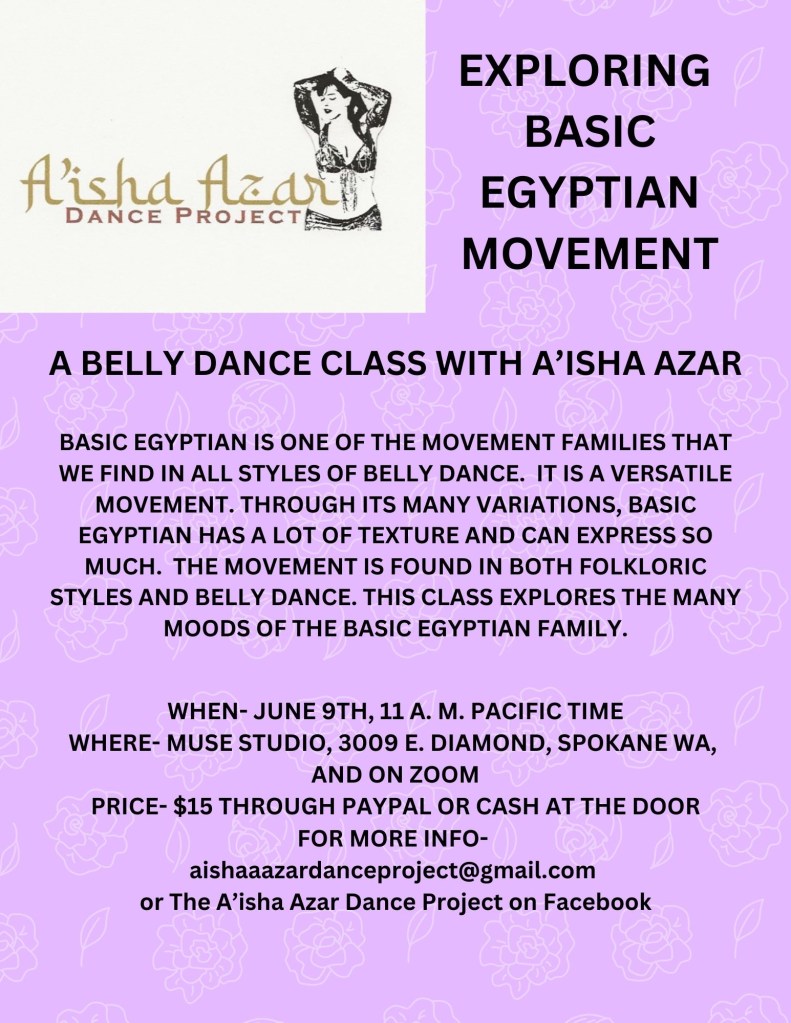
Our June 9th Porject class is taking us back to one of the very basic concepts in Belly Dance/Raqs Sharqi/Oriental Tanza. Basic Egyptian is seen in every form of the dance that I can think of, including all of the MENA dance inspired dances such as FCBD and Tribal Fusion.
Basic Egyptian is a trochanter based movment that can be executed in so many different ways and interpret so many different thing in the music. Our class is part of my EXPLORING series. We start at the beginning and work our way through variations, layering and phrasing. Its a class that I am always excited to teach. If you are interested in more info or joining the class, please get in touch either on Facebook or at Aishaazardanceproject@gmail.com
JUNE 1ST, 2024
Happy Meteorological summer, everyone! Yes, solstice and Equinox are nice, but I like changing the seasons this way more. Its a constant conversation between my husband and me.
Even though I am retired from performance, I did end up performing a bit yesterday. One of our dancers has Covid and could not be there, so I filled in. I must admit that i really have to work not to be rusty on stage. Its amazing to me that I still feel so at home when teaching class, as if its right where I am supposed to be, but that the stage has become a foreign land in some ways. I wonder if other dancers of longevity feel this way. As of July 1st, I will be celebrating my 50th year in Middle Eastern/ North African dance. I took my first class on July 1st, 1974. The Dance continues to be a journey that I am so fortunate and happy to be taking. Though the road has changed, I am still completely enthralled by the adventure!
MAY 26, 2024- TEACHING WITH THE STUDENT IN MIND
This blogging is heady stuff. I want to sit down and let dance observations flow from my brain to the page. The subject matter is so ubiquitous that it is hard to know where to start.
I would like to talk a bit about my teaching method. The first thing that comes to mind is something that I once said to one of my students who was just starting to teach. All teachers need to recognize that the dancers who come to us for class are every bit as important as the material we are imparting. Sometimes it is easy for us to overlook that.
I don’t know how many classes and workshops I have taken where I felt more like a herd animal than an individual human. At some point I recognized that I did not like that, and I vowed to be the kind of teacher who SEES the dancers in my classes as individual people with skills and challenges unique to themselves. I want to be treated like that in class and I hope I live up to that goal when I teach my classes and workshops.
One of the most helpful things for me was finding a tool to help me define the ways in which people learn so that I could better understand how to teach to the individual. A developmental psychologist named Howard Gardner developed a theory of teaching that took into consideration that people have different ways of learning. In 1983 he wrote a book called FRAMES OF MIND: THE THEORY OF MULTIPLE INTELLIGENCES. It is a book that is well worth reading for teachers of any kind. The premise is that people learn in different ways, often more than one, and that many people do have a predominant way of learning. Some learn by listening, some by doing, some by observing, etc. The message to teachers is to try to find out how people learn in order to better meet their instructional needs. This theory became my bible. I want every single dancer in my classes to feel as if, even for a minute, I am acknowledging them personally. I want them to know I SEE them. I want each person to leave my class with something of personal value to themselves.
And now, on to the material. As important as the dancers in class is the material we present. As an instructor, I need to know how to break down movement, how to reconstruct it, how to express to dancers that movement is the physical manifestation of the music. This is not only its notes and tones and rhythms, but also its emotional content. Dance is thing of the heart and soul, not just the body moving around. As such, we always explore what the music is offering us in the way of sharing it. It is partly what it is and partly who we are. We are defining the music through its culture, its composer, the point of view of the version we are dancing, and through our own emotional lens as well.
Now, all of this is a lot to take in for beginners, so we sneak it in here and there in class, through cultural anecdotes, through talking about how that violin or drum rhythm makes us feel, through info about composers and by telling them way the words to songs say. There are a thousand gentle ways to assist the dancers in our classes to come to a place in their dance journey where they know there is so much more.
May 22, 2024- ABOUT WORLDVIEW
Hello everyone. I have never blogged before so this is an entirely new experience. Over the years I have written articles for various dance magazines and many, many pages of notes for classes, so I should be able to put something of interest to dancers in this section. Hold on while I refresh my coffee!
I’ve been dancing lo these many years (50, to be exact!), and have seen so many changes. In the end some things stand out for me. One of them is that Worldview definitely influences what we see, how we dance, how others see our dance. So, what, exactly, is Worldview?
Worldview, as seen through the scope of cultural anthropology is a sort of holistic way of describing how a culture leaves its mark on the way we see things. This cultural mark influences every aspect of our lives. Of course, people within any given culture are individuals, with individual ways of looking at things, but at the same time, we are strongly influenced by the cultures in which we grow up and live.
This is one reason why it is difficult to dance exactly like people from cultures of origin. It requires us to step outside of our usual beliefs, thoughts and emotional systems and see things through others’ eyes as much as possible.
Worldview is why Egyptian and Lebanese Raqs Sharqi, Turkish Oriental Tanza, and American Cabaret Belly Dance all have such diverse personalities and ways of manifesting physically. Dance is never only about dance. It is about generations of human beings influencing belief systems and each of us living in those systems so that our dance is representative of who we are as part of a culture and a People.

 A’isha Azar Dance Project